Cornfields and Cannon: How Arsenal Quietly Won Over Middle America
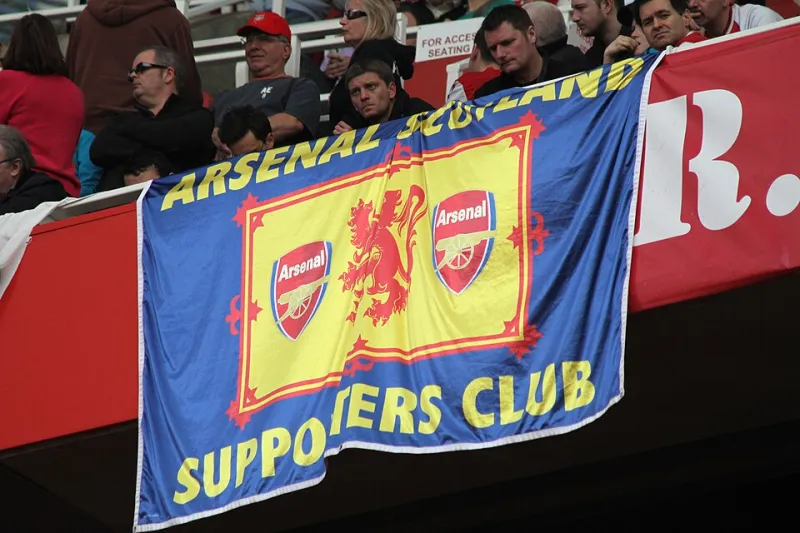
Photo: Ronnie Macdonald from Chelmsford, United Kingdom, CC BY 2.0, via Wikimedia Commons
Walk into a certain bar in Indianapolis on a Saturday morning and you'll find something that would have seemed genuinely bizarre fifteen years ago: a packed room of people in red and white, clutching coffee cups, watching Arsenal press high up the pitch against a side from Merseyside or Manchester. Some of these folks grew up watching the Colts. A few played high school soccer and drifted away from the game. Others stumbled onto a Premier League broadcast during a lazy weekend and never quite left.
Arsenal's American fanbase has been growing for years, but the conversation tends to center on the coasts — New York, LA, maybe Chicago. What gets talked about less is the quiet, steady expansion happening in the midwest and the south, in cities that aren't exactly known as soccer hotbeds. Kansas City. Nashville. Indianapolis. Raleigh. Places where the local sports calendar is dominated by college football, NASCAR, and the NFL. And yet, somehow, the Gunners have found their people there too.
So how did it happen?
The Streaming Effect
It's hard to overstate how much Peacock and TNT Sports (and before that, NBC Sports) changed the accessibility equation for American fans. When Premier League coverage became genuinely easy to find — not buried on some obscure cable tier, but right there on a platform you already had — casual curiosity could actually turn into habit.
"I honestly just had Peacock for the Olympics and then one Saturday I was flipping around and there was an Arsenal game," says Marcus T., a member of the Arsenal America supporters' branch in Kansas City. "I didn't know anything about the club. I just thought the way they played was beautiful. That was three years ago. Now I'm setting alarms for 7 AM kickoffs."
That kind of origin story comes up over and over when you talk to newer supporters in these markets. The barrier to entry dropped, and Arsenal's playing style — when it's clicking — tends to be the kind of thing that holds attention even for someone who doesn't yet know the names on the back of the shirts.
Style Points Matter
American sports culture has always had a soft spot for teams that play the right way. There's something in the DNA of how we talk about sports here — the Golden State Warriors at their peak, the early-2000s Colts offense, the Showtime Lakers — that responds to style and system, not just results.
Arsenal, especially under Mikel Arteta, fits that frame. The high press, the quick combinations, the positional rotations — it reads as intelligent football to a viewer who's used to thinking about systems and schemes. That's not nothing in a market where the average fan understands spread offenses and defensive shifts.
"People ask me why Arsenal and not Liverpool or City," says Priya M., who helps run a Nashville supporters' group that meets at a downtown bar every matchday. "I always say it's the how. Arsenal makes you feel like you're watching something being built. Even when it goes wrong, you can see the idea. That's compelling."
The flip side, of course, is that Arsenal's occasional tendency toward frustrating draws and last-minute heartbreaks also resonates in a deeply human way. American sports fans know about lovable near-misses. The Cubs existed for a century. Suffering is a love language.
Social Media Did the Heavy Lifting
The club's social media presence deserves real credit here. Arsenal's accounts — particularly on Instagram and TikTok — have leaned into personality, humor, and behind-the-scenes content in a way that translates well to American audiences who aren't already steeped in Premier League culture.
When Bukayo Saka does something ridiculous in training and it ends up as a Reel, that clip doesn't require any context. It's just a guy being exceptional and joyful about it. That's universally watchable. The club has also been reasonably smart about engaging with American cultural moments — showing up in conversations around the Super Bowl, March Madness, you name it — without it feeling forced.
"The content team clearly knows what they're doing," says Derek F., a supporter in Indianapolis who runs a small Arsenal-focused newsletter for local fans. "It's not just highlights. There's personality to it. You start to feel like you know these players, and that's when it becomes your team."
The Supporters' Club Experience
One thing that often gets overlooked in these conversations is the role of local supporters' clubs in converting casual viewers into committed fans. Arsenal America has branches scattered across the country, including in cities that might surprise you, and the community element is genuinely powerful.
Showing up to a bar where thirty other people are just as invested as you are — where someone explains the offside rule without making you feel dumb, where you learn the chants, where people buy rounds after a win — that's a different experience than watching alone on your couch. It creates a social infrastructure around the fandom that makes it stickier.
In Kansas City, Marcus's group has grown from a handful of regulars to over sixty members on their group chat. In Nashville, Priya says they've had to move venues twice because they kept outgrowing the space. These aren't massive numbers, but they represent something real: a community that sustains itself and recruits new members organically.
What Makes Arsenal Specifically
Here's the thing worth sitting with: a lot of what we've described — good streaming access, social media, supporters' clubs — is true for other Premier League clubs too. So why are Arsenal specifically the ones building these pockets of devoted support in Middle America?
Part of it is probably timing. The current squad is young, exciting, and genuinely likable. Saka, Martin Ødegaard, Leandro Trossard — these are players with distinct personalities and obvious quality. Part of it is the ongoing project feel of the Arteta era, which gives newer fans something to invest in emotionally beyond just trophies.
But there might also be something about the club's identity that clicks with a certain type of American fan. Arsenal has always had a reputation for being a thinking person's club — the history of beautiful football, the intellectual tradition of managers like Arsène Wenger. That appeals to the kind of fan who wants to understand what they're watching, not just cheer for the biggest name.
Whatever the reason, the red and white is showing up in places nobody would have predicted a decade ago. In the heartland, in the south, in cities where soccer was an afterthought. And from what we can tell, those fans aren't going anywhere.